kg/m² to kN/m²: Load Units for Engineers
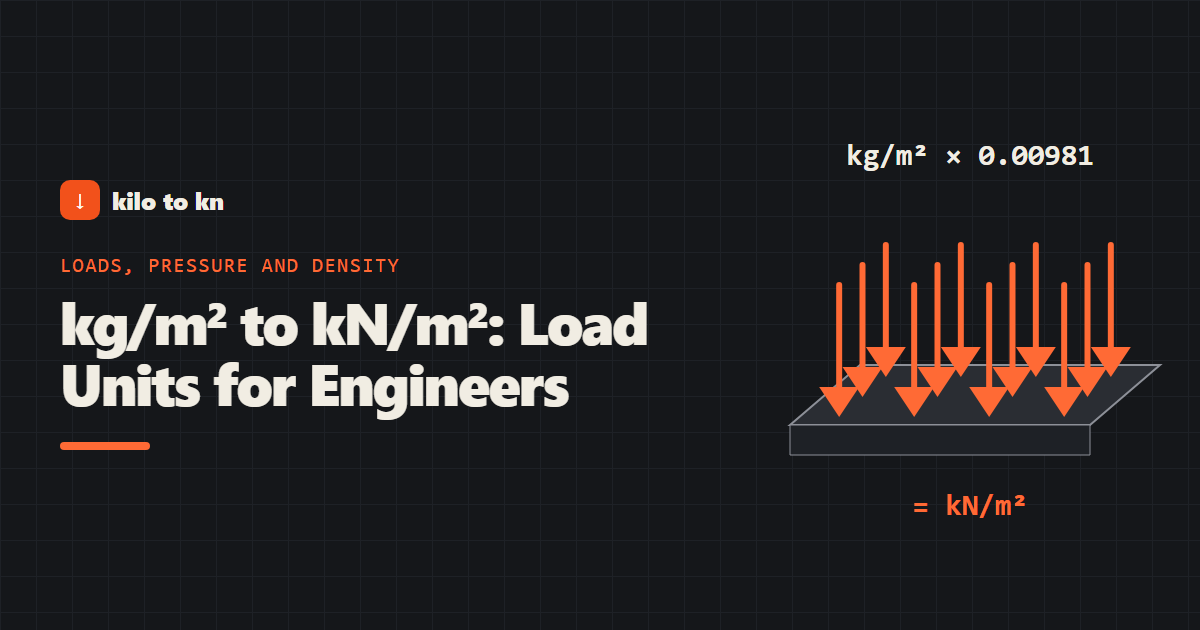
To convert kg/m² to kN/m², multiply by 0.00980665. 1 kilonewton per square metre (kN/m²) equals 101.97 kilograms per square metre (kg/m²) and exactly 1 kilopascal (kPa).
A load in kg/m² is a mass spread over an area. A load in kN/m² is the force that mass presses down with, and design codes use force.
The kg/m² to kN/m² Formula
The formula is q (kN/m²) = q (kg/m²) × 9.80665 ÷ 1,000.
Standard gravity, 9.80665 m/s², turns kilograms into newtons, and ÷ 1,000 turns newtons into kilonewtons. The square metre stays on both sides.
kg/m² to kN/m² Conversion Table
| kg/m² | kN/m² (= kPa) | psf (lb/ft²) |
|---|---|---|
| 50 kg/m² | 0.49 kN/m² | 10.2 psf |
| 100 kg/m² | 0.98 kN/m² | 20.5 psf |
| 150 kg/m² | 1.47 kN/m² | 30.7 psf |
| 200 kg/m² | 1.96 kN/m² | 41.0 psf |
| 250 kg/m² | 2.45 kN/m² | 51.2 psf |
| 300 kg/m² | 2.94 kN/m² | 61.4 psf |
| 500 kg/m² | 4.90 kN/m² | 102.4 psf |
| 1,000 kg/m² | 9.81 kN/m² | 204.8 psf |
For pounds per square foot (psf), multiply kN/m² by 20.885.
Typical Floor Loads in kN/m²
Eurocode EN 1991-1-1 gives recommended imposed loads (the people, furniture and stored goods on a floor) for 4 common uses:
| Floor use | Imposed load | In kg/m² |
|---|---|---|
| Homes (category A) | 1.5–2.0 kN/m² | 153–204 kg/m² |
| Offices (category B) | 2.0–3.0 kN/m² | 204–306 kg/m² |
| Areas with tables, such as cafés (category C1) | 2.0–3.0 kN/m² | 204–306 kg/m² |
| Shops (category D1) | 4.0–5.0 kN/m² | 408–510 kg/m² |
Countries set their own values in a National Annex. In the United States, ASCE 7 gives 40 psf (1.92 kN/m²) for homes and 50 psf (2.39 kN/m²) for offices.
Dead Load: Slab Self-Weight
Dead load is the weight of the structure itself. Reinforced concrete has a unit weight of 25 kN/m³ in EN 1991-1-1, so a slab’s dead load is its thickness times 25:
| Slab thickness | Dead load | In kg/m² |
|---|---|---|
| 150 mm | 3.75 kN/m² | 382 kg/m² |
| 200 mm | 5.00 kN/m² | 510 kg/m² |
| 250 mm | 6.25 kN/m² | 637 kg/m² |
Floor finishes, screed and ceilings add 1.0–1.5 kN/m² in a typical building.
From Characteristic Load to Design Load
The loads above are characteristic values. Eurocode design multiplies them by partial factors before checking a beam or slab: 1.35 for dead load and 1.5 for imposed load in the common combination.
Example for an office slab: 1.35 × 5.0 kN/m² + 1.5 × 3.0 kN/m² = 11.25 kN/m² design load.
Related Load Units
Engineers meet 3 related units next to kN/m²:
- kg/cm² to kN/m²: multiply by 98.0665. Old soil bearing reports and pressure gauges use kg/cm².
- kN/m³: unit weight of a material, used to turn thickness into kN/m².
- kN/m: line load along a beam, kN/m² times the width the beam supports.
Unit conversion gives the numbers. Load combinations, safety factors and national rules come from the design code and a qualified engineer.
Questions
Is kN/m² the same as kPa?
Yes, 1 kN/m² equals exactly 1 kilopascal (kPa). A pascal is one newton per square metre.
How many kg/m² is 1 kN/m²?
1 kN/m² equals 101.97 kg/m² under standard gravity.
What is a typical floor load for a house?
Eurocode EN 1991-1-1 recommends 1.5 to 2.0 kN/m² imposed load for residential floors, about 153 to 204 kg/m².