Kg to kN on Earth
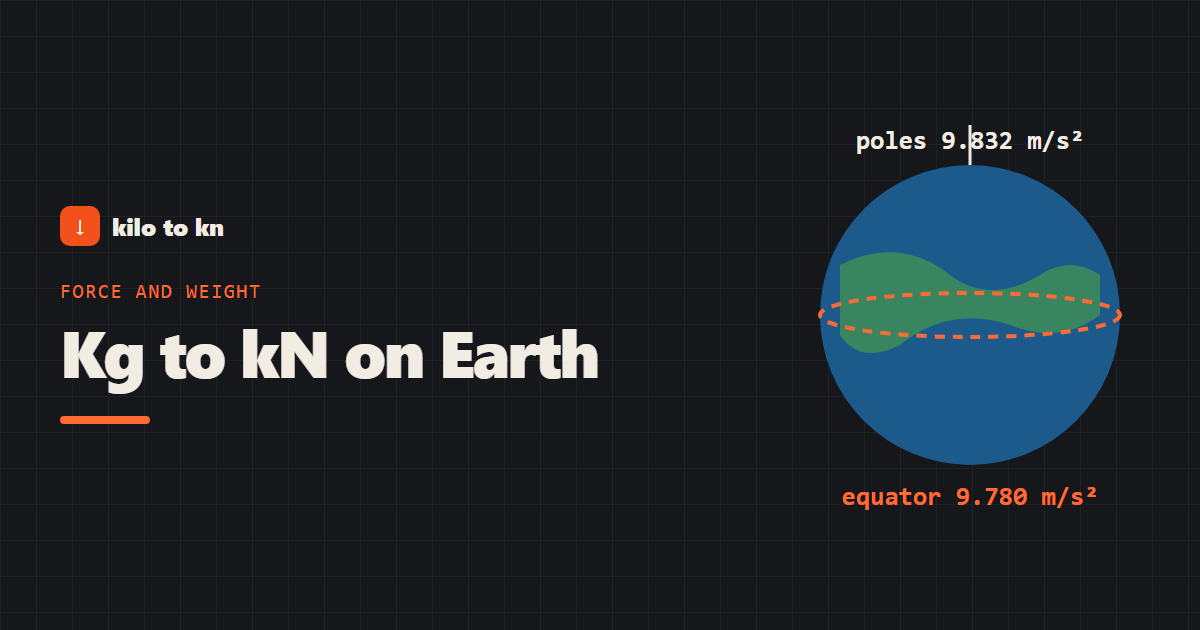
On Earth, 1 kg weighs 0.00980665 kN (9.80665 N) under standard gravity. Real gravity at sea level runs from 9.780 metres per second squared (m/s²) at the equator to 9.832 m/s² at the poles, so the same kilogram (kg) weighs up to 0.53% more at the North Pole than at the equator.
The mass never changes. The kilonewton (kN) value changes with the gravity at the spot where the mass sits.
Why kg to kN Uses 9.80665
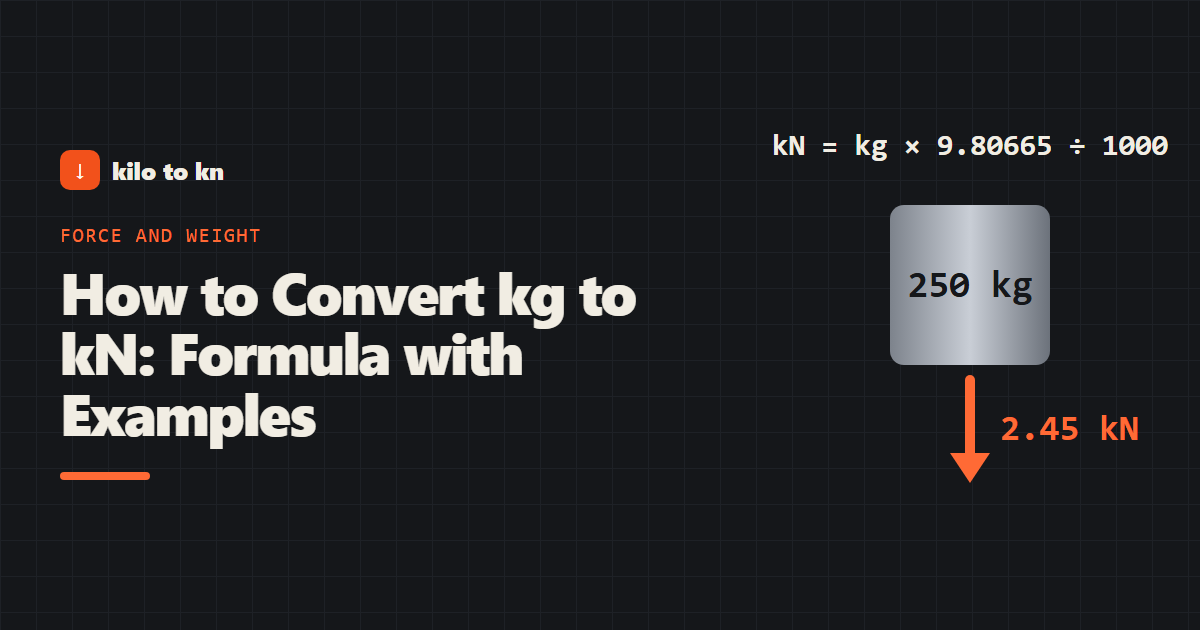
Kg to kN conversions use standard gravity (g₀) = 9.80665 m/s², a fixed value set by the 3rd General Conference on Weights and Measures (CGPM) in 1901. The number sits close to gravity at 45° latitude at sea level.
A fixed value gives every engineer, supplier and load chart the same answer. A 1,000 kg crane load reads 9.81 kN in Brazil, Norway and Japan.
Gravity on Earth by Location
Gravity on Earth changes with 2 things: latitude and altitude. The table shows the weight of 1,000 kg (1 metric tonne) at 6 locations.
| Location | Gravity (m/s²) | Weight of 1,000 kg |
|---|---|---|
| Equator, sea level | 9.780 | 9.780 kN |
| Standard gravity (g₀) | 9.80665 | 9.807 kN |
| 45° latitude, sea level | 9.806 | 9.806 kN |
| Poles, sea level | 9.832 | 9.832 kN |
| Mount Everest summit (8,849 m) | about 9.76 | about 9.76 kN |
| International Space Station orbit (400 km) | about 8.7 | about 8.7 kN |
The International Space Station (ISS) sits inside strong gravity. Astronauts float in free fall, not in zero gravity.
Latitude
Gravity rises from the equator to the poles for 2 reasons. Earth spins, and the spin pushes outward hardest at the equator. Earth bulges at the equator, so a point on the equator sits about 21 km (13 miles) farther from the centre than a point on a pole.
Altitude
Gravity drops by about 0.003 m/s² for every 1 km (0.62 miles) of height. A 1,000 kg load on a mountain at 3,000 m weighs about 9 N (0.009 kN) less than the same load at sea level.
When Local Gravity Matters
Local gravity matters in 3 cases:
- Precision scales. Laboratory and legal-for-trade scales measure force, so each scale is calibrated for the gravity where it stands.
- Load cells. A load cell set up in one city and moved to another latitude reads a slightly different force.
- Physics experiments. Pendulum and free-fall experiments use measured local g.
For building design, lifting plans and unit conversion, standard gravity is the norm. The 0.5% spread is far smaller than the safety factors in design codes.
Kg to kN Beyond Earth
The same formula, kN = kg × g ÷ 1,000, works on any planet with its own gravity:
| Body | Gravity (m/s²) | Weight of 100 kg |
|---|---|---|
| Earth | 9.80665 | 0.98 kN |
| Moon | 1.625 | 0.16 kN |
| Mars | 3.72076 | 0.37 kN |
| Jupiter (cloud tops) | 24.79 | 2.48 kN |
The kilo to kN converter on this site has buttons for all 4 bodies. Switch from Earth to the Moon and the force arrow shrinks to one sixth while the 100 kg block stays the same size.
Questions
Does 1 kg weigh the same everywhere on Earth?
No, 1 kg weighs between 9.780 N and 9.832 N depending on latitude and altitude. The mass stays 1 kg.
Which gravity value should I use for kg to kN?
Use standard gravity, 9.80665 m/s², for design and unit conversion. Local gravity matters only for precision weighing.
How much does 1 kg weigh on the Moon?
1 kg weighs 1.625 N (0.001625 kN) on the Moon, about one sixth of its weight on Earth.