How to Convert kg to kN: Formula with Examples
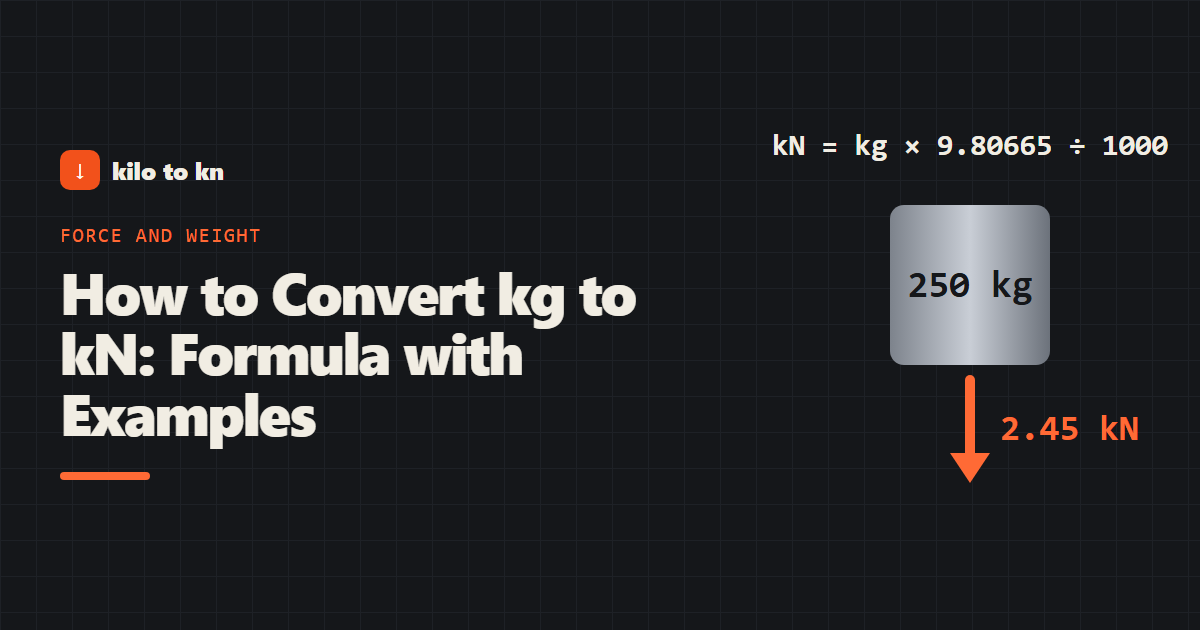
To convert kg to kN, multiply the mass in kilograms (kg) by 0.00980665. The kg to kN formula is kN = kg × 9.80665 ÷ 1,000, where 9.80665 metres per second squared (m/s²) is standard gravity (g₀).
A kilogram measures mass and a kilonewton (kN) measures force. The conversion turns a mass into its weight: the force that mass presses down with on Earth.
The kg to kN Formula
The kg to kN formula is F (kN) = m (kg) × 9.80665 ÷ 1,000.
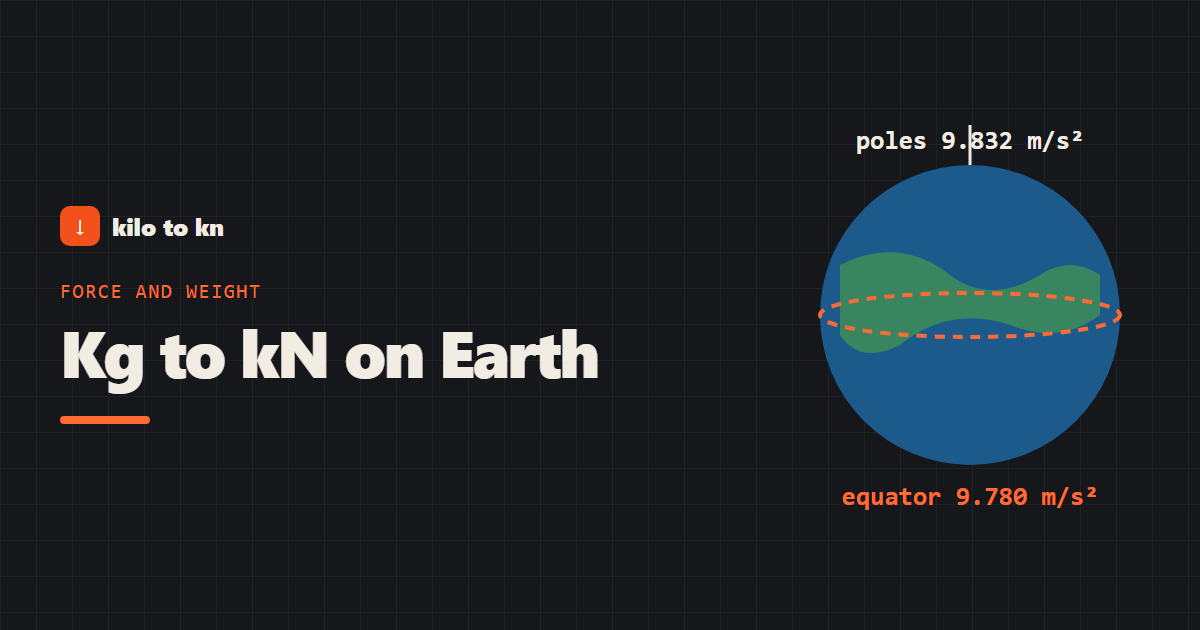
The formula comes from Newton’s second law of motion, force equals mass times acceleration (F = m × a). Weight is the force of gravity on a mass, so the acceleration is standard gravity, g₀ = 9.80665 m/s². The 3rd General Conference on Weights and Measures (CGPM) fixed that value in 1901.
Mass × g₀ gives newtons (N). One kilonewton is 1,000 newtons, so the last step divides by 1,000. Both steps together give one factor: 9.80665 ÷ 1,000 = 0.00980665.
| Factor | Value |
|---|---|
| 1 kg in kN | 0.00980665 kN |
| 1 kg in N | 9.80665 N |
| 1 kN in kg | 101.971621 kg |
| 1 kN in lbf | 224.809 lbf |
How to Convert kg to kN in 3 Steps
To convert kg to kN, follow 3 steps:
- Write the mass in kilograms. Convert first, if the mass is in grams (÷ 1,000) or pounds (× 0.45359237).
- Multiply by 9.80665 to get the weight in newtons.
- Divide by 1,000 to get kilonewtons.
Example for 250 kg: 250 × 9.80665 = 2,451.66 N, and 2,451.66 ÷ 1,000 = 2.45166 kN.
8 Worked Examples
The table converts 8 common masses from kg to kN, with newtons and pound-force (lbf) for comparison.
| Mass | Weight in kN | Weight in N | Weight in lbf |
|---|---|---|---|
| 1 kg (2.2 lb) | 0.0098 kN | 9.81 N | 2.2 lbf |
| 10 kg (22 lb) | 0.098 kN | 98.07 N | 22.05 lbf |
| 50 kg (110 lb) | 0.49 kN | 490.33 N | 110.2 lbf |
| 75 kg (165 lb) | 0.74 kN | 735.5 N | 165.3 lbf |
| 100 kg (220 lb) | 0.98 kN | 980.67 N | 220.5 lbf |
| 500 kg (1,102 lb) | 4.90 kN | 4,903.3 N | 1,102.3 lbf |
| 1,000 kg (1 t) | 9.81 kN | 9,806.7 N | 2,204.6 lbf |
| 2,500 kg (2.5 t) | 24.52 kN | 24,516.6 N | 5,511.6 lbf |
A 2.5 t load on a crane hook pulls with 24.52 kN. A 75 kg person stands on a floor with 0.74 kN.
How to Convert kN Back to kg
To convert kN to kg, multiply kilonewtons by 101.971621. The result is in kilogram-force (kgf): the mass that weighs that many kN under standard gravity.
Example: 5 kN × 101.971621 = 509.86 kg. A sling rated at 20 kN holds 2,039 kg (2.04 t).
Quick Estimate: Divide by 100
A fast mental check divides kilograms by 100. The estimate runs 2% high: 1,000 kg ≈ 10 kN, and the exact value is 9.81 kN. Use the estimate to spot a typo, and use the exact factor for drawings, reports and load charts.
3 Common kg to kN Mistakes
The kg to kN conversion goes wrong in 3 common ways:
- Skipping the ÷ 1,000. The answer comes out in newtons, 1,000 times larger than kN.
- Skipping gravity. Dividing kg by 1,000 gives tonnes, a mass, not kN. The result is 9.81 times too small.
- Mixing kN with kn. Capital N is the newton. Lowercase kn is the knot, a speed of 1.852 km/h.
The National Institute of Standards and Technology (NIST) lists the exact factor in NIST Special Publication 811: 1 kgf = 9.80665 N. Every converter on this site uses the same value.
Questions
How many kN is 1 kg?
1 kg has a weight of 0.00980665 kN (9.80665 N) under standard gravity.
How many kg is 1 kN?
1 kN equals the weight of 101.97 kg (101.971621 kgf) on Earth.
Is dividing kg by 100 a good estimate for kN?
Yes, for a rough check. Dividing by 100 gives a result about 2% high: 1,000 kg ≈ 10 kN, and the exact value is 9.81 kN.