Does 1 kg Equal 1 Litre?
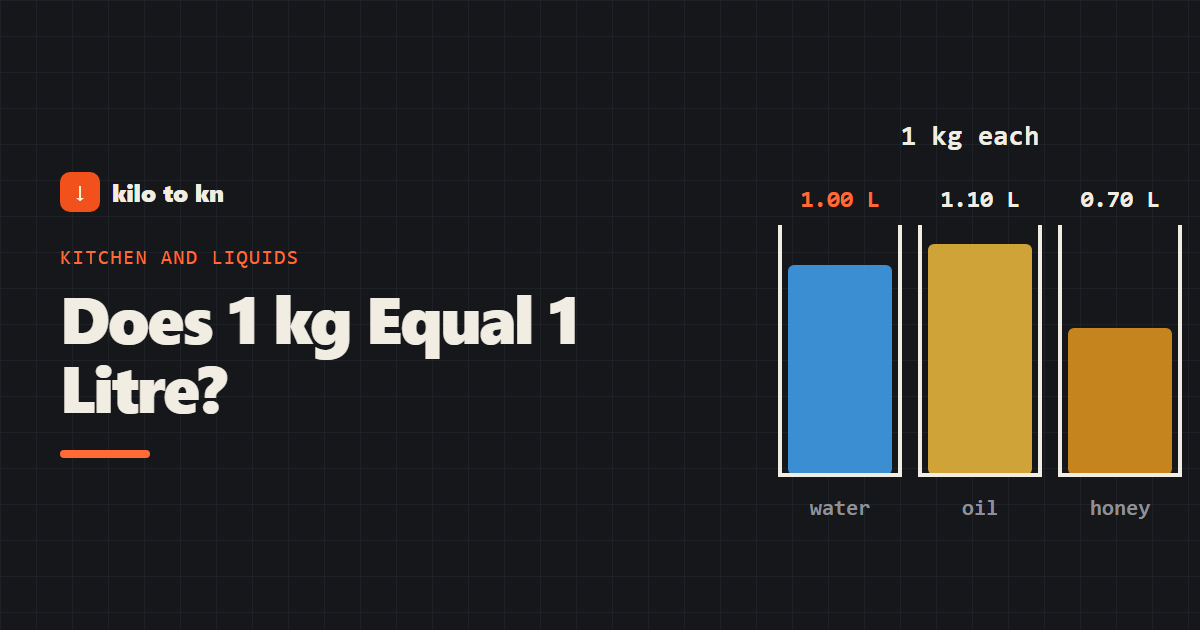
Yes, 1 kg of water fills 1 litre (L). The match holds for pure water at about 4 °C (39.2 °F), where water density is 1 kilogram per litre (kg/L). For any other liquid, 1 kg fills a different volume: 0.97 L for milk, 1.10 L for olive oil and 0.70 L for honey.
A kilogram (kg) measures mass and a litre measures volume. Density links the two units.
Why Water Gives 1 kg per Litre
Water gives 1 kg per litre by design. The French metric system of 1795 defined the kilogram as the mass of 1 cubic decimetre (dm³) of water, and 1 dm³ is exactly 1 litre.
The definitions have moved since then. The General Conference on Weights and Measures (CGPM) set the litre equal to exactly 1 dm³ in 1964, and the kilogram has used the Planck constant since 2019. Water still lands within 0.003% of 1 kg/L at 4 °C.
Water Weight per Litre by Temperature
Water expands as it warms, so 1 litre weighs a little less at higher temperatures:
| Water temperature | Mass of 1 litre | Volume of 1 kg |
|---|---|---|
| 4 °C (39.2 °F) | 0.99997 kg | 1.00003 L |
| 20 °C (68 °F) | 0.99821 kg | 1.0018 L |
| 60 °C (140 °F) | 0.98320 kg | 1.0171 L |
| 100 °C (212 °F) | 0.95840 kg | 1.0434 L |
For cooking and shopping the difference is too small to matter. For laboratory work, use the density at the measured temperature.
How to Convert kg to Litres
To convert kg to litres, divide the mass in kilograms by the density in kg/L:
litres = kg ÷ density (kg/L)
Example: 2 kg of honey ÷ 1.42 kg/L = 1.41 L. To go the other way, multiply: 3 L of milk × 1.03 kg/L = 3.09 kg.
1 kg of 8 Common Liquids in Litres
8 common liquids give 8 different volumes for the same 1 kg:
| Liquid | Density (kg/L) | Volume of 1 kg | Volume in US cups |
|---|---|---|---|
| Water | 1.00 | 1.00 L | 4.23 cups |
| Sea water | 1.025 | 0.98 L | 4.13 cups |
| Milk | 1.03 | 0.97 L | 4.10 cups |
| Olive oil | 0.91 | 1.10 L | 4.65 cups |
| Honey | 1.42 | 0.70 L | 2.98 cups |
| Petrol (gasoline) | 0.74 | 1.35 L | 5.71 cups |
| Ethanol | 0.789 | 1.27 L | 5.36 cups |
| Mercury | 13.53 | 0.074 L | 0.31 cups |
Liquids lighter than water, such as oil and petrol, fill more than 1 litre per kilo. Liquids heavier than water, such as honey, fill less.
Dry Ingredients Do Not Follow the Rule
1 kg of a powder or grain never fills a fixed volume. The volume depends on how loosely the grains pack. 1 kg of flour fills about 1.7–1.9 L, and 1 kg of granulated sugar fills about 1.2 L. Weigh dry ingredients instead of measuring them by volume.
Weight of a Litre in Newtons
1 litre of water weighs 9.81 newtons (N), or 0.0098 kilonewtons (kN), on Earth. A 1,000 L (1 m³) water tank presses on its supports with 9.81 kN, a figure engineers use to size tank stands and floors.
Questions
Is 1 litre of water exactly 1 kg?
No, 1 litre of water weighs 0.99997 kg at 4 °C and 0.9982 kg at 20 °C. The difference is under 0.2% at room temperature.
How many litres is 1 kg of oil?
1 kg of olive oil fills 1.10 litres (density 0.91 kg/L).
How do I convert kg to litres?
Divide kilograms by the density in kg/L. 2 kg of milk ÷ 1.03 kg/L = 1.94 L.